
Call 650 324 2373 | Text 408 520-1585
Fall Classes Start August 17
It’s Not Too Late to Enroll!
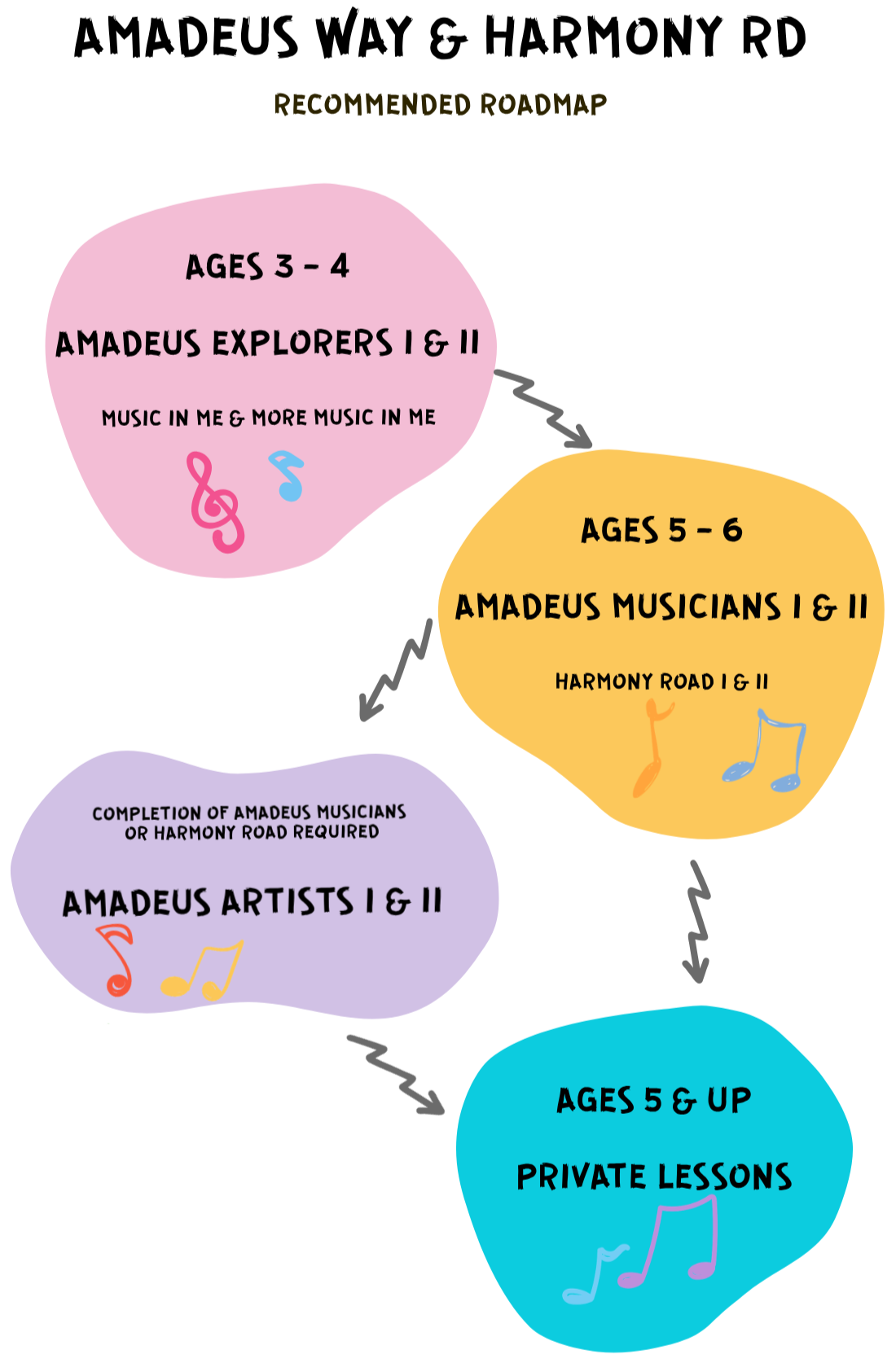
Aren't private lessons better than group lessons?

We believe that taking private lessons is the most ideal form of learning for older children and adults. Though there are exceptions, our years of experience have shown us that private lessons are not necessarily appropriate for very young children.
Private lessons for beginners typically concentrate on working through the primers and learning to read notation. Technique and repertoire are the main ingredients. (Gibb, 1993).
Although the emphasis on technical work and notation during instrumental lessons are absolutely necessary, if too much of it is introduced to a young piano student from the onset, it can stifle his/her creativity and musicianship. In terms of brain usage, technical skills and note reading are based largely in the left hemisphere. Students who are taught this way from an early age never learn to listen properly to themselves and are unable to play with feeling. Once these students learn to rely on notation for their music, it becomes increasingly difficult to explore musical avenues that do not have a notational basis. (Evans, 1985, Priest, 1989.) Most teachers surveyed rated the following components as low priority: only 63% covered playing-by-ear; only 54% included improvisation; only 49% taught composition. (Odam, 1195, Gibbs, 1993, Thompson, 1984 and Jorgenson, 1986)
Before 1850 pianists routinely learned not only to interpret but also to improvise and compose on the piano. After this date, piano performance was gradually transformed into a reproductive art. The accomplishments of all round musicians were lost as interpretation and technical prowess took priority. (Gellrich and Parncutt,1998).
The dominance of notation in verbally oriented and teacher-led lessons leads to hours of practicing where the body is fully occupied but the brain is not engaged at all. Traditional method books encourage students to listen "a note at a time"; their physical movements and coordination are shaped for life by that kind of listening. Most traditional instrument lessons are teacher-centered rather than student-centered. Telling children to do their best to please their teacher causes nervousness and anxiety which leads to muscular and emotional tension. The focus on technique has also been shown to be responsible for unnecessary physical tension leading to injuries. Tension also results when children have no clear mental perception of the music in and of itself. (Chappell, 2001)
Why should I take Amadeus Way?

Christine’s student, Abigail’s composition (age 6)
Amadeus Way at New Mozart School of Music is expertly crafted by Christine Shin, the school’s director with 20 years of experience in early childhood music education and 37 years of experience in piano and voice pedagogy. Read her full bio here.
Collaborating with her husband, Dr. Paul Lee, a Stanford-educated cognitive psychologist, Christine has designed New Mozart’s Amadeus Way to stand out from other early childhood music programs.
The curriculum has been meticulously developed and refined to ensure students achieve their full potential. Amadeus Way offers a strong foundation for advanced musical training and foster a lifelong appreciation for music.
Lessons include:
Keyboard discovery and playing
Solfege singing and ear training
Rhythm activities and movement
Creative activities and composing.
How is New Mozart’s Amadeus Way different?

Kinder programs are European music and movement programs based on the belief that every child is musical. From birth to age seven children can participate without pressure to perform, as they are encouraged to explore, express and discover. The curriculum is based on child development and age appropriate learning through music. 90% of the program is based on folk music and dance.
In an attempt to teach music to children from a developmental perspective, many group music appreciation programs have proliferated. Some provide music interpretation, dancing and singing to folk tunes, or playing simple percussion instruments in kindergarten style rhythm bands.
All group music lessons are not created equally:
Pre-school music play programs do not teach your child to play a musical instrument.
They do not include parents as key teaching resources after the age of three or four.
They do not focus on teaching solfege singing (naming notes using do-re-mi) as the musical foundation for developing inner hearing, listening, feeling and music reading.
Some of them are activities to pass time, and not investments in the child's academic or musical future.
Amadeus Way students learn to play piano, compose and improvise. In Amadeus Way, parents participate fully in each lesson and coach their children at home throughout the week. Amadeus Way incorporates the rhythm and movement of Orff and Dalcroze, the solfege singing of Kodaly and the child centered learning approach of Montessori. Our classes follow a time tested early childhood philosophy that centers on the dynamic triangle of parent or caregiver, child, and highly trained early childhood music educator working together.
The incredible musicianship and technical skill that results from this combination results in young musicians who are truly gifted repertory performers and creative composers. Our program is rooted in the old European teaching model of comprehensive musicianship, which produced Mozart, Beethoven and Bach. Remember the great composers did not only play the classics, they wrote them!
Do I need to buy a piano to start Amadeus Way?
Although acoustic piano is our first choice, a touch sensitive keyboard can be purchased for teaching the very young (Amadeus Explorers). For students in Amadeus Musicians, a digital piano with weighted keys is recommended. Fortunately affordable digital pianos are available and can be used until the student is ready for more serious piano study later down the road.
How does the tuition work?
You pay by 18 week semester. Go here for details.
Want to Enroll...Now What?
To register online, complete this enrollment form. You can pay online using your credit card.
To register by phone or onsite, You can give us a call or come into our office during our office hours.